 EN
EN
Shengan Building A, Hengzeng Road Chang'an Town Dongguan City,
Guangdong, China, Zip Code: 523880
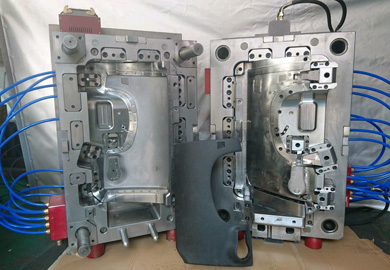
2K molding (two-shot molding) produces multi-material parts in a single machine cycle, using two injection units and a rotating or index mold. It delivers stronger bonding, higher precision, and better efficiency for large-scale production.
Overmolding is a two-step process, where a second material is molded over a pre-formed substrate. It offers greater flexibility and lower tooling complexity, making it suitable for lower volumes or more complex insert scenarios.
The right choice depends on production volume, material compatibility, bonding strength, and cost efficiency.
2K molding, also known as two-shot injection molding, is a process where two different materials are injected sequentially within the same mold during a single production cycle.
First material is injected into the mold (substrate layer)
Mold rotates or shifts position
Second material is injected onto or around the first shot
The final bonded part is ejected
Fully automated process
Strong molecular bonding between materials
High repeatability and precision
Ideal for high-volume production
Typical applications include:
Soft-touch handles
Sealed electronic housings
Automotive interior components
Overmolding is a process where a pre-molded or pre-assembled part (substrate) is placed into a mold, and a second material is injected over it.
First part is manufactured separately
Part is inserted into a second mold
Second material is injected over the substrate
Final bonded product is formed
Flexible production setup
Compatible with insert molding (metal, electronics)
Lower initial tooling investment
More manual or semi-automated processes
Common applications:
Tool handles with rubber grips
Medical devices
Consumer electronics casings
| Aspect | 2K Molding | Overmolding |
|---|---|---|
| Production Method | Single-cycle, automated | Multi-step process |
| Cycle Time | Faster in mass production | Slower due to handling |
| Labor Requirement | Low | Medium to high |
2K molding is significantly more efficient for large-scale production due to its integrated workflow.
2K molding
Strong chemical bonding
Excellent adhesion between materials
Overmolding
Mechanical or partial chemical bonding
Adhesion depends on material compatibility and surface prep
For applications requiring airtight sealing or structural bonding, 2K molding is typically preferred.
2K molding
Requires specialized machines with dual injection units
Higher upfront tooling cost
Advanced mold design (rotary platen, index systems)
Overmolding
Standard injection machines can be used
Lower tooling complexity
Easier to implement in existing facilities
This is why many companies initially work with 2k molding factories only when scaling production.
2K molding
Limited by machine capabilities and mold structure
Requires precise synchronization of materials
Overmolding
Greater flexibility in part design
Can incorporate metal inserts, electronics, or pre-assembled components
Overmolding is often chosen for complex assemblies or hybrid products.
| Cost Factor | 2K Molding | Overmolding |
|---|---|---|
| Tooling Cost | High | Moderate |
| Unit Cost | Low (at scale) | Higher |
| Labor Cost | Low | Higher |
2K molding → high initial investment, lower cost per unit
Overmolding → lower initial cost, higher long-term production cost
You should consider working with experienced 2k molding suppliers when:
Production volume is high
Strong bonding between materials is required
Consistency and precision are critical
Product requires integrated sealing or soft-touch surfaces
Typical industries:
Automotive
Consumer electronics
Household appliances
Overmolding is more suitable when:
Production volume is moderate or low
Product includes inserts (metal, PCB, etc.)
Design flexibility is required
Budget constraints limit tooling investment
Typical industries:
Medical devices
Hand tools
Prototyping and custom products
Material compatibility is a key factor in the 2k moulding process.
Common combinations include:
PC + TPE
ABS + TPU
PP + TPE
The success of bonding depends on:
Melt temperature compatibility
Chemical affinity
Surface energy
Improper material pairing can lead to delamination or weak adhesion.
Initial tooling and machine investment for 2K molding is higher. However:
For large production volumes → 2K molding is more cost-effective
For small batches → overmolding is more economical
The decision should be based on total lifecycle cost, not just tooling.
Poor bonding between layers
Flash at material interface
Misalignment during mold rotation
Insert misplacement
Weak adhesion
Air traps or voids
Proper design, material selection, and process control are essential to minimize these issues.
Selecting the right partner among global 2k molding factories or overmolding suppliers is critical.
Experience with multi-material molding
In-house mold design capabilities
Material engineering expertise
Quality control systems
Ability to scale production
At GMMoldTech, we provide:
Advanced 2K molding solutions
Flexible overmolding services
End-to-end support from design to mass production
2K molding and overmolding serve similar purposes—combining multiple materials into a single part—but they differ fundamentally in process, efficiency, cost structure, and application scope.
Choosing the right method requires a clear understanding of your product design, material requirements, and production scale. For high-volume, high-precision applications, 2K molding delivers superior performance. For flexible, lower-volume production, overmolding remains a practical solution.
2K molding is a single-cycle, automated process using dual injection units, while overmolding involves multiple steps and separate molding stages.
2K molding generally provides stronger bonding due to better material integration during the molding process.
Partial automation is possible, but it typically cannot match the efficiency of fully integrated 2K molding systems.
Automotive, electronics, and appliance industries widely use 2K molding for high-volume, precision components.
Evaluate based on production volume, product complexity, material requirements, and total cost of ownership rather than just initial tooling cost.

 Call us on:
  Email Us:
  Shengan Building A, Hengzeng Road Chang'an Town Dongguan City,